


Author: Prakash Rai
Solar Robots That Are Making Lives of Humans Simpler
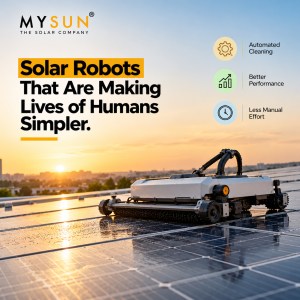
Robots have been parts of our lives for decades now. If you have been following the narratives of the past year or so, it is widely rumored that robots will eventually replace humans, at least in most production factories. Various assembly lead industries have been using fully or semi-automated machines to improve efficiency and decrease labour costs. With technology advancing rapidly, we come across news reports on daily basis about innovations in the robotics which have the potential to change our lives. But, what about solar robots?
Interestingly, robots, are no more confined within the factories they have entered all spheres of our lives. They’re being used in schools, hospitals, restaurants, defence and many other areas today.
In an age where there is so much focus on energy, scientists all across the globe have started looking for alternatives which could be used to fuel these robots and make them more efficient so that they can work non-stop for longer durations. Robots fitted with solar cells are certainly capturing the imagination and can be the future of robotics due to the low fuel cost. A couple of Solar Robots have already been released in the market and we wanted to share about them:
Solar Robot Name: Tertill
Designed by: Franklin Robotics.
Purpose: Removes weeds from your garden.
Fuel Source: Runs on solar energy.
Tertill is a Robot manufactured by the Massachusetts-based company, Franklin Robotics. The Robot is capable of patrolling your garden and cutting off the unwanted weeds on daily basis. In short, it replaces your gardener. The company has developed it using the same prototype of its popular robot ‘Roomba’, the vacuum cleaner. Unlike most Robots, instead of using high-tech cameras, Tertill uses simple height sensors to differentiate whether plants are desired or they are unwanted weeds. It leaves the plants which are taller than 1 inch but it chops off those of lesser height. It doesn’t uproot weeds from the ground but cuts them with the help of a small nylon string that spins rapidly to cut the weeds.
To inform Turtill that you want to keep a small plant, you just have to surround it by plant collars which are provided along with it. This lets Turtill know that it is the desired plant. It doesn’t use any chemicals for eliminating the weeds, which helps in maintaining the fertility of the soil as well as does not infect the plants. It is waterproof too and can work even in the cloudy weather. One more interesting thing is that you don’t have to stand by its side when it is working, its performance can be monitored on your smartphone via an app which uses Bluetooth to send information such as the quality of the soil, weather and robot’s activity. Truly a digital garden keeper, powered by solar. You can find more on the Solar Robot Tertill here.
Solar Robot Name: S5s Security Robot
Designed by: SMP Robotics
Purpose: Patrolling and Surveillance
Fuel Source: Solar powered
S5s Security Robot is developed by the SMP robotics company which has made a name for itself in designing security robots. These Robots are being used for surveillance and patrolling the security borders, however, the conventional robots require access to electrical grids, which leads to an added cost. However, this is where the S5s stands out. S5s robot is equipped with solar panels and thus can perform continuous video surveillance even in the areas where grid connectivity is unavailable.
It is capable of independently navigating and can also change its viewing positions. It is equipped with an auto motion tracking PTZ camera with x36 optical zoom which allows the robot to keep track of passageways from a significant distance. S5s features six 360 degree cameras which help it to monitor all directions without a fuss. This robot also has an inbuilt motion sensor that sounds an alarm in case of any movement in its close proximity. It connected to a control room through WiFi from where it receives commands to change positions. The robot can potentially revolutionize the way surveillance is done in the modern times. The fact that it is powered by solar, is a huge bonus too. You can find more on Solar Robot S5s here.
While these are just two solar robots, we look forward to several more of them powered by solar in the future. Make sure you share the article with your friends on social media so they are up to date with the prowess of solar.
China’s Latest Solar Powered Drone is Capable of Spending Months on End in the Air

China has developed an unmanned solar powered drone which can stay in the air for months, if not years. The aircraft is called Caihong or Rainbow and is developed by China Academy of Aerospace Aerodynamics (CAAA). It is China’s first domestically designed solar-powered drone which managed to reach a height of 20,000 feet during its test flight. However, during one of the secret test-runs, it managed to fly up to a height of about 65,000 ft. This drone has a wingspan that is over 40 meters wider as compared to the wingspan of the Boeing 737 passenger aircraft. As a reference, the wingspan of a B737 stands at about 34 meters wide. The aircraft has a cruising speed of about 150 to 200 km/h. Caihong is touted as the world’s second largest unmanned plane trailing behind a NASA model. China now has become the third country - after US and UK - in the world to own a solar-powered drone that is capable of flying at a height of 65,000ft.
In comparison, fuel powered conventional drones have a service ceiling of about 26,000 feet. The reason solar drones are able to beat the conventionally fueled drones here is that solar powered drones do not have a need to be constantly refueled and therefore can fly higher. Caihong will be primarily used for early airborne warning, aerial reconnaissance, disaster monitoring, meteorological observation and communications relay. According to reports, China is likely to sell the design of this drone to other countries as well.
Drones have become a vital part of our lives and are being used for various reasons ranging from defense, security to more commercial uses such as enabling home deliveries. With advancement in technology, their use is expected to rise manifold. Solar powered drones definitely are a future prospect as they serve as an excellent alternative to the conventional drones and save the all-important fuel costs to keep an aircraft airborne. With wonderful examples like the Solar Impulse 2 and now the Caihong, we may not be all that far from seeing a proper passenger jet, powered by solar alone.
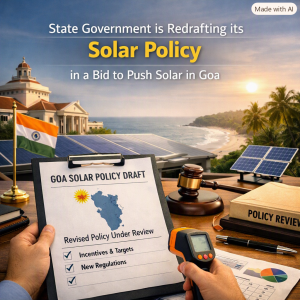
State Government is Redrafting its Solar Policy in a Bid to Push Solar in Goa
- All types of land will now be utilized for setting solar power projects. This also includes agricultural land. There will be no need of converting any private land from one type to the other before setting up a project. This move is likely to appeal to solar companies who are looking to install large solar parks.
- State Nodal Agency will create a record of non-productive Government lands and make them available for setting solar power plants. For every 1MW project, Developers will be provided with 1.5 hectares of land. These lands will be provided free of cost for a long-term lease of 25 years which can further be extended for 5-10 years.
- There will be no need for specific permissions from any local body/ PDA/ Municipal Corporations or other Urban Development Bodies or Panchayats for setting up solar plants in existing or new buildings etc.
- State Government will also promote the development of Solar Power Plants on the Canal tops and Canal banks.
- The State Nodal Agencies will give full support to eligible consumers to avail any benefits declared by the State or the Central Government in form of incentives and subsidies, though no new subsidies by the Goa Government have been announced.
- Government Nodal Agency will provide a fair Net-Metering facility to all the eligible consumers within the area of supply of DISCOM.
- Residential consumers will be encouraged to install rooftop Solar PV over their roofs for generating their own electricity and the surplus generation can be fed back to the grid under the net-metering system. Several other states like Delhi, MP etc are already encouraging residential customers opting for solar to go with Net Metering.
- For rooftop solar, the minimum capacity shall be equal to or more than 1KWp but not more than 500KWp.
- The individuals including commercial users are allowed to go for Gross metering up to 10kW or sanctioned load whichever is lower. This facility is provided by very few states. Gross metering will be available to all properties except Government buildings.
- The Goa State Government has also come up with a unique offering known as Group Net Metering. It is similar to Net Metering system but one or more properties are treated as one and their electricity usage is considered equivalent to one.
- Developers will be given 50 per cent exemption on stamp duty if they take private or government land on lease for development of solar power projects.
- Any solar power produced or consumed within the State will be exempted from electricity duty and cess.
- Solar equipment purchased for installation of solar plants shall be exempted from VAT and Entry tax. A similar move was initiated by the Haryana Government, which exempted solar devices, equipment and parts used in the installation of solar power projects, from VAT, last month.
- No wheeling charges will be levied on consumers for consuming solar power within the state.
- For maximum utilization of all available lands and rooftops, the State Government has proposed a unique system. Banking of electricity will be given to the producers of surplus generation. This electricity banking system will work like any other conventional bank where we deposit money and then withdraw it as per requirements, with only difference that, in this bank one will be allowed to store surplus electricity which can later be used as per requirement. This system will solve many problems at one go such as encouraging people to utilize their whole roof for maximum production and doing away from the batteries which anyway lead to an increase in the system cost.
- Single window clearance will be provided to the developers.
- The State Government has also proposed a time framework to ensure that developers complete their projects within the stipulated time. They can take 180 and 365 days for setting up rooftop solar and ground mounted projects respectively from the day of their approval; failing which they’ll have to seek fresh approvals.
- It has proposed to make it mandatory for the High-tension (HT) consumers of the State with a sanctioned load of 100KW or more to generate solar PV power to meet the Solar RPO obligation.
- All applicants will have to pay Rs. 50/- per KW along with the application to the distributor licensee. For solar power plants equal to or more than, 100KW capacity developers will have to pay Rs. 10,000/- which will be non-refundable.
18% GST on Solar Cells and Modules; 5% GST on Solar Power Generating Systems

The Goods and Services Tax, also known as GST, is hailed as one of the biggest tax reforms of India and is expected to have a major impact on our economy. The main objective of this reform is to bring uniformity and transparency in the taxation system. In the latest GST council meeting, the agenda was to discuss and fix tax rates for 1211 commodities. The council proposed that few basic items will have no tax while other items will fall under four slabs i.e., 5%, 12%, 18% and 28%. But, what will be the effect of GST on solar?
The GST Council proposed that 18% tax be levied on solar cells and modules while coal was put in the lower tax slab of 5% against its current tax incidence of 11.69%. People related to the solar industry were either expecting complete exemption or a place in the 5% tax slab. However, it appears that the sharp decrease in solar tariffs and equipment cost have convinced the government that this sector doesn’t require any financial incentives. This argument was further strengthened by the renewable energy minister Piyush Goyal, who said, “Solar and wind energy have hit record lows and the industry is now able to stand on its own feet without any support.”
According to Bridge to India, this tax rate of 18% will increase module costs by 18%, inverters by 12%, and service costs by 3% therefore, the overall project cost will go up by about 12%.
Some key points worth pondering upon are:
- This move will increase the overall cost of the under development and under construction projects. According to industry estimates, the overall project cost may go up by 12~14% which would mean that the developers will have to do with much lesser returns than what they would have bid for. Also, the lenders will also start raising questions on the viability and Debt serviceability of these projects.
- If the impact of GST is passed on to the consumers, then the DISCOMs will resist the increase of tariff rates in a time when solar tariffs for newer auctions are reaching all-time lows while on the other hand solar sector will have to reanalyze its power tariff to make-up for the increased cost of solar production.
- The government provides up to 30% capital subsidy for rooftop solar projects on one side and on the other hand, they have introduced this additional tax on solar panels. It remains to be seen how the Central Government looks at this irony.
It definitely is an unexpected hike which will have a domino effect on the industry and might result in delay of some ongoing projects. This will also have an impact on the rooftop industry which has started showing early signs of finally seeing some growth. This additional cost levied by GST on Solar will act as a deterrent for its quick growth and consumer acceptability.
We expect that the government will quickly take stock of the negative impact of the proposed GST structure on the solar industry and work out a mechanism whereby the growth of solar at this crucial juncture for the industry is not stymied. If the rooftop solar systems (which includes Solar Panels) come under 5% GST across India, as it seems from the paper published by the GST Council, then it is a big step forward and the residential, commercial and industrial consumers should take up this opportunity to Go Solar with a uniform tax rate. However is the effect of GST on Solar, as your personal solar advisors, we hope the move to GST will not be an obstacle to the positive traction that the industry is seeing and the Government will act in the best interest of the consumers, like you, who are interested in going solar.
Visit www.itsmysun.com or Dial 9818507770 for all your queries related to buying a solar system for your home, office or building. Post Update: It is mooted that on June 3, a revised figure could be announced. In the mean time, the Revenue Secretary has tweeted the following:All solar equipments and its parts would attract 5% GST only https://t.co/Dqcq2IctOQ
— Dr Hasmukh Adhia (@adhia03) May 28, 2017
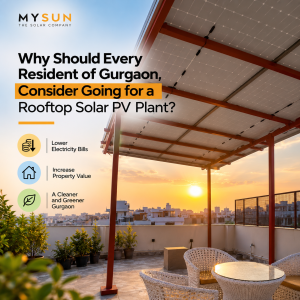
Why Should Every Resident of Gurgaon, Consider Going for a Rooftop Solar PV Plant?
- You can bring down your electricity bill by 20-30% and you’re assured of the same tariff for at least 25 years. For example, if you have a monthly bill of Rs.5000 by going solar you can save around Rs.1100 from the very first month and not just this in just 25 years you’ll save around 4.4 lac by investing just Rs.40,600. Don’t believe us? See it for yourself via our solar calculator...
- Going solar is a one-time and risk-free investment with an assured return between 15-30% p.a.
- If you have a residential property then you are eligible for a 30% subsidy with maximum amount being Rs. 17,070/kWp by Solar Energy Corporation of India (SECI), however, it should be noted that this subsidy is on the first-come-first-serve basis.
- The state has an effective Net-Metering Policy in place which will be governed by Haryana Government Renewable Energy Department (HAREDA), where the power generated in excess can be fed back into the grid and this way a user can not only save but also potentially make money by going solar.
- Not only this Value Added Tax (VAT), Electricity taxes, cess, electricity duty, wheeling charges, cross subsidy charges, transmission and distribution charges have been waived off completely for both Ground Mounted and Rooftop Solar Projects.
- Exemption from External Development Charges, Scrutiny Fee and Infrastructure Development Charges for the time during which the solar power plant is operational. This brings some clarity to those involved in Civil and Construction of newer projects and will now help them incorporate Solar as a part of the project, easily.
- No clearance is required from Haryana Pollution Control Board and would help in accelerating the pace at which projects are executed.
- The large projects of MW scale will be provided 100% exemption from payment of fee and stamp duty charges for registration of rent/lease deed for the land required for setting up of these projects.
- Clearances and approvals would be provided through single window clearance (HAREDA) to the developer (within 60 days after submission of complete application, enclosures, fees including LOI).
- No processing fee is required for this procedure, however an earnest money deposit of Rs. 2.00 lacs will need to be deposited (Rs. 200/ kW) which is refundable after signing of the PPA.
- 25 paise per unit rebate on electricity bill will be given to the users feeding electricity back to the grid.



 Book your Solar System for just 6,999 and build your personalized payment plan with Flexi-payTM.


