


Author: [email protected]
Big announcement on Solar Subsidy for Homes
Government of India, through Ministry of New and Renewable Energy vide its Office Memorandum dated June 10 2022 has simplified the process for availing subsidy for rooftop solar systems for residential grid-connected rooftop solar plants.
Key highlights:
- The national portal for subsidy is open now.
- Subsidy shall be available only through this National Portal
- Homeowners can buy solar from any registered vendor of their choice
- Directly given to the homeowner on solar installation
- Subsidy so available shall be same all over the country
- Rates of subsidy will be notified for each calendar year
- The amount of subsidy is fixed - Rs14588/- per KW upto 3KW and Rs 7294/- per KW for additional capacity upto 10 KW.
- People having electricity connections directly from DISCOM - state or private are eligible.
- Only domestically manufactured panels using domestically manufactured cells to be used. (presently only polycrystalline panels upto 335W available in this category).
- You have to fill the capacity applied for subsidy while applying online (Please connect with your MYSUN Solar advisor to know your suitable capacity.
- The project price will be directly decided between the supplier and beneficiary based on capacity and site. The subsidy amount will not depend on this.
- The scheme is open only upto 31 Dec 2022.
According to us, this is a very positive step by the government. Now, homeowners can decide to go with quality solar companies without compromising on the quality and more importantly the service of their solar systems. This will also enable the solar industry to consolidate and develop a robust and elaborate sales and service infrastructure for rooftop solar.
MYSUN is running a special drive to help homeowners interested in subsidy and to curate their journey for a seamless and transparent experience.
For more details connect with your solar advisor at : +91 919873167009 or email us at: [email protected]
Why Solar is the need of the hour?
Unlike fossil fuels, which we use daily to generate energy, solar power could be used to generate sustainable, clean energy that is environmentally benign.
Because fossil fuels are non-renewable, they will eventually run out.
As a result, humanity must pool its resources to be ready for the day when non-renewable energy sources run out — that will only occur if solar power is used.
We shall discuss why solar power is vital for individuals, nations, and the entire ecosystem in this article.
- Generating Solar Power is Easy
Have you ever wondered what would happen if we ran out of natural gas and oil?
Daily, why should anyone be able to function?
Almost everything would be lost, including electricity, transportation, the internet, as well as other amenities. That is where solar energy fits in: it can be produced using sunshine. We can easily create power because we have plenty of sunlight. This is accomplished by the use of solar panels, which capture the sun's light and convert it to energy. That energy can be utilised to produce electricity, among other things. We would never run out of sunlight, unlike the other sources of energy. As a result, solar electricity will be available and simple to utilise for a long time.
- Solar Power Is Clean and Safe
Fossil fuels and other sources of energy can be difficult to manage, and tragic accidents can occur, putting lives at risk. Furthermore, incidents using fossil fuels might result in damage bills totalling millions of dollars. Solar electricity, on either hand, is both easy and safe to use. Solar power is linked to a limited number of (perhaps non-existent) mishaps. Solar electricity is a natural and environmentally benign source because it is generated by sunshine. In the long run, relying on fossil fuels for energy can be harmful to the environment, as gas emissions contribute to the greenhouse effect, which would be a worldwide concern for many countries. Fossil fuel emissions have an impact on the quality of our water, air, and food. The more we burn, the more other resources get polluted, and our health is jeopardised. According to estimates, as pollution worsens, our world will continue to lose animal and plant species. If pollution proceeds, humanity will have lost more species in the next 60 million years than we have in the previous 60 million.
- Solar Power Will Cut Down on Your Bills
With the advancement of technology and the growth of consumer culture, many individuals are finding it difficult to pay their electrical and utility bills, which may be rather large at times. Individuals can reduce their electric bills and save money by using solar power. "But what if it rains or snows?" may be a common sceptic's question. "What if the sun doesn't shine?" Numerous solar panels are now constructed and classified according to performance, size, and other variables. Larger solar panels can capture a greater amount of sunshine, which will almost always result in an energy excess. This solar panel would be able to produce more energy than the individual's home consumes, with the remainder being conserved for rainy, dreary days. Your utility bills would remain unpredictable with electricity because it is entirely dependent upon your consumption rate. Using solar power and solar panels, however, you will not only be able to fully eliminate energy expenses, but you will also be able to foresee any bills that you may have to pay. It's time to use solar energy to reduce your utility bills.
- Can Be Used for A Variety of Tasks
Solar energy and Rooftop solar panels are well-known for their versatility. You can use photovoltaic solar panels to generate electricity or thermal solar panels to heat your home or business. Solar panels, unlike electricity, do not give access to the power grid. Solar energy can help poor countries and country regions clean water, provide heat, and other services. A large number of individuals who do not have access to energy or clean water can now be helped thanks to the various applications of solar panels. Another unexpected benefit of solar power and panels is that they might increase the value of your home. This may appear unusual at first, but because solar-powered homes have no utility expenditures, they are appealing to purchasers. Solar-powered homes appear to purchasers and leasing agents to be comparable to homes with reduced property taxes. Finally, having solar panels placed in your home may increase the cost of your home. Get install solar panels from the best company in India.
- Low Maintenance
Solar power and solar panels, unlike electricity cables and other items, require little to no upkeep and the little hassle there can be further minimised with MYSUN Assure - 25 yr service support from MYSUN. You only need to clean them on a routine basis to keep them in good shape. If you don't like cleaning or are concerned about damaging your solar panel, then you hire a cleaning service. Cleansing and housekeeping is a business that is developing at a quicker rate than it has ever been. As a result, finding someone to wash your solar panels and you for a nominal price isn't difficult. Furthermore, the majority of solar panel manufacturers include a lifetime warranty (20 - 30 years). There will be no parts to replace, so there isn't much opportunity for error. It's possible that only one part has to be replaced (every ten years). This section is in charge of transforming energy into electricity. Apart from that, there isn't much that can be modified. Again, finding organisations that provide services at reasonable pricing isn't difficult.
To summarise, solar energy benefits not just the environment, and also individuals, small and large businesses, and governments. Solar energy can provide numerous benefits, like reduced carbon footprint, lower expenses, and much more.
Innovative Solar Solutions Including Pergolas for Homes by MYSUN
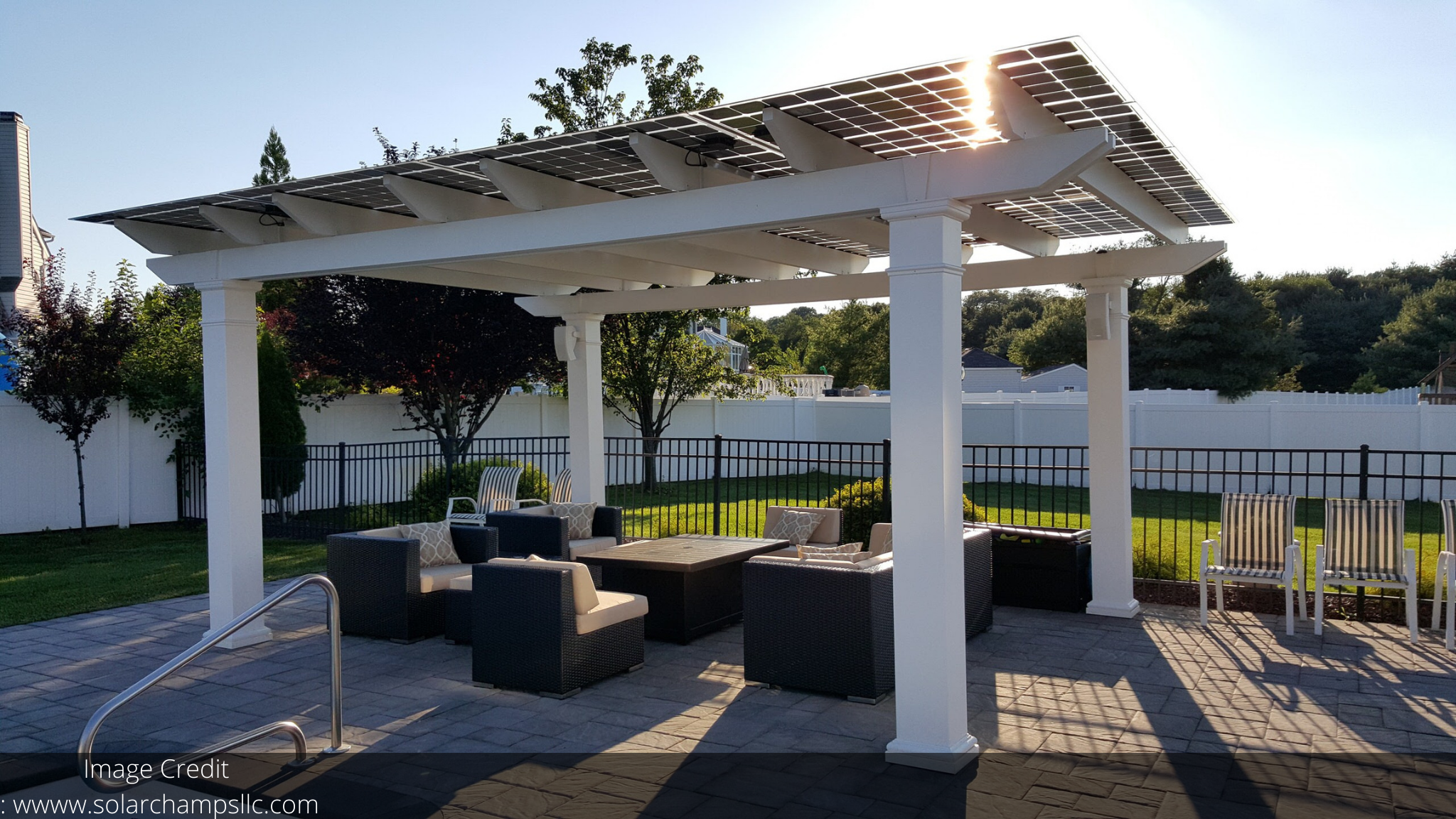
As the preferred solarization partner of thousands of homes, commercial buildings, and industrial rooftops, at MYSUN, we are committed to bringing the best solar experience to our customer base. This commitment drives us to innovate and come up with a range of solutions that is not only economically favourable but also aesthetically pleasing. In line with the thought, at MYSUN we recently announced a wide range of products for our Residential customers, including solar pergolas.
We are delighted to introduce ‘MYSUN for Homes’ with our innovative new range of products and customer experience and first-of-its-kind ‘Live under your Solar System’ concept. Let’s look at the offerings in detail right here.
Cyra
- Cyra is perfect for your home if you have an RCC Roof and are planning to install solar on a Terrace, Balcony, or even go for a Ground Mounted Solar Plant.
- The chief material of the solar pergola is galvanized steel and you have a wide range of options including - low to high height options.
- Cyra is perfectly suitable for homes/ buildings and can cover unused areas like water tanks, store-room, DG sets, etc. This way you will utilise your rooftop to generate electricity, while you reduce your electricity bills very substantially.
- Cyra pergola is ideal for consumers looking to get the best value from their solar systems and forms the starter in our wide range of solar for homes category.
In terms of pricing, you are looking at Rs 52,000 ~ Rs 65,000/kWp.
Book your Cyra Solar System from MYSUN here.
Arbor
- Arbor is the perfect solar product, a premium pergola to make beautiful terrace ground seating areas.
- It comes with an extra-wide MS column post with 2.5m to 3m high structures in Metallic Finish, which really adds to the aesthetic appeal.
- Arbor is perfectly suitable for villas, bungalows, homes, buildings, pools, and patios. So if you have an independent home, Arbor can be a fantastic addition to your property.
- Another interesting feature is the option for a glass-on-glass solar panel.
- If you like, you can also opt for Add-ons like high-end flooring, lighting, and complete green-scaping.
In terms of pricing, you are looking at Rs 75,000 ~ Rs 82,000/kWp.
Book your Arbor Solar System from MYSUN here.
Canopas
- The Canopas Pergolas or Gazebos combine next-level elegance and aesthetics with incredible utility.
- They come with Wooden finish (WPC) structures reinforced with steel for luxurious exteriors.
- In case of a Canopas Pergola, you are looking at 2.5m to 3m high structures.
- They are perfectly suitable for villas, bungalows, homes, buildings, pools, and patios.
- Just like Arbor, you also have glass-on-glass solar panel options.
- There are also add-ons like high-end flooring, lighting, and complete green-scaping here.
In terms of pricing, you are looking at Rs 110,000 ~ Rs 125,000/kWp.
Book your Canopas Solar System from MYSUN here.
So, if you are located in the Delhi / NCR region, which includes, Delhi, Noida, Greater Noida, Ghaziabad, Gurgaon, Faridabad etc, get in touch with us today to book your solar pergola from MYSUN. Don’t forget to ask our solar advisors for the offer of the month.
Note: GST extra on all the costs mentioned above.
How Much Money Can You Save By Going Solar?

While the environmental benefits of going solar are well documented, and it is widely considered to be a viable solution to help us overcome the rising problem of climate change, one often overlooked advantage of going solar is the financial benefits it brings. When you are producing your own electricity using your rooftop solar system, you are inherently not dependent on the local electricity supply helping you save up to 80%* on your electricity bill monthly. Using net-metering, you can potentially also export the excessive power that you may have produced and further import it at the night time when your system is not producing the energy.
Another point to note is that for a rooftop solar system, the tariff for the next 25 years is decided at the time you sign the PPA (Power Purchase Agreement). This potentially insulates you from inflation and shocking rise in price of electricity due to external factors like the coal crisis the country is going through helping you to plan your expenses. Most of the solar systems, depending on their size and capacity have a payback period of about 3-4 years. This means, for all practical purposes, you are going to be producing your own power and consuming it for free.
Let’s try and understand the financial benefits of going solar through our in-house developed tool, which is the MYSUN Solar Calculator and give you a quick snapshot of your solar savings potential within ten seconds. All you need to do is input your location, electricity bill amount and the category of your establishment and you have all the information you need to make an informed decision about going solar.
We will take an example of a residential home in New Delhi at Vasant Kunj, which is spending about INR 6,000 every month on an average on their electricity bill. This amount but obviously will be higher in summers, owing to the ACs that will be operating and slightly lower in the times of winter when the power utilization is lower. On that note, you would be interested to note that your solar system is perfectly capable of handling all the loads of your property, provided the capacity of the system while designing is appropriate. This is why at MYSUN, our engineering team spends a lot of time analysing your electricity bill and personalising a solution that gives you most economical yet, highest possible returns on your investment making your journey towards solarization comfortable and rewarding.
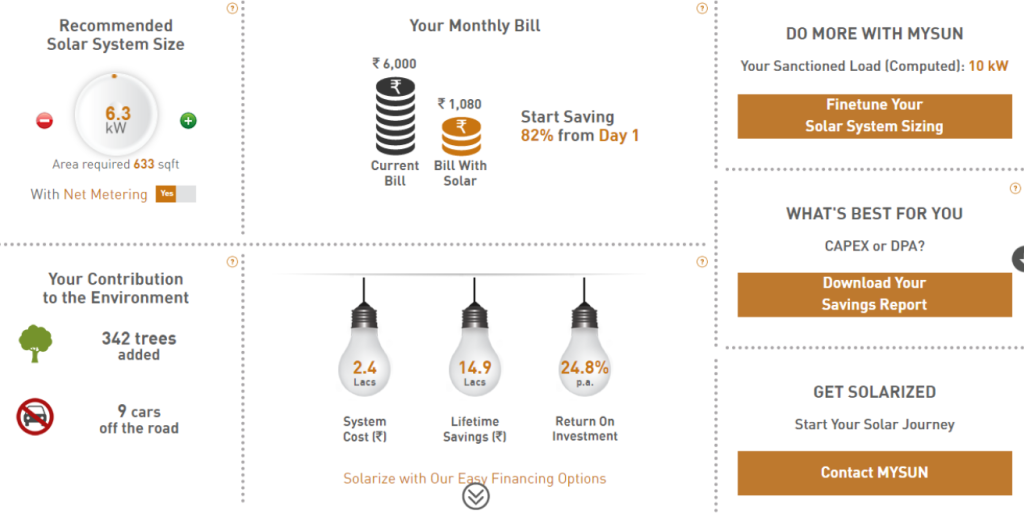
Let’s get back to the example we were talking about. For the bill amount of INR 6,000 a month, the solar calculator recommends a system of 6.3kW, which will allow you to save almost 82% on your monthly electricity expenses. Your system will pay itself back in less than 5 years. In fact, you can utilise this link to be able to go through our findings.
Not only this, you can avail a variety of financial offerings that MYSUN has to make your journey even more affordable on your pocket.
So, there you have it, you stand to save Lakhs and Lakhs of Rupees over the 25 years lifetime period of your solar system. So go ahead, and give your MYSUN Solar Advisor a call and get started on this journey of mega savings.
Net Metering is now approved for rooftop solar systems with capacities of up to 500 kW.

The Union Ministry of Power has released the long-awaited net metering policy for rooftop solar installation rules under the Rights of Consumers Rules 2020. The new rules allow prosumers to get net metering for up to 500 kW or the sanctioned load, whichever is less, and gross metering for loads over 500 kW. The commission has implemented time-of-day tariffs to encourage consumers to install energy storage. They can use the stored solar energy or feed it into the grid at peak hours.
With the use of net metering, net-billing, or net feed-in, the distribution licensee may install a solar energy meter to measure the gross solar energy generated by the grid-connected rooftop solar system for the purpose of renewable energy purchase obligation (RPO) credit, if any. The commissions may also allow gross metering for prosumers who choose to sell all of their generated solar energy to the distribution licensee rather than using net metering, net billing, or net feed-in. The commission will determine the feed-in tariff for gross metering in accordance with tariff laws.
Net metering for rooftop solar installations was previously limited to one megawatt (MW) until the government considered further reducing it to 10 kW in December 2020.
Several industry experts argued that prohibiting net-metering above 10 kW would be detrimental to micro, small, and medium-sized businesses operating in the rooftop segment.
The Top 5 states with the highest number of installed rooftop solar capacities in India are Rajasthan, Maharashtra, Tamil Nadu, Karnataka, and Gujarat, making close to 50% of India’s total solar capacity. Know more about each state’s solar policy.
The arrangements for net-metering, gross-metering, net-billing or net feed-in shall be in accordance with the regulations made by the State Commission, from time to time.
MYSUN’s Take
At MYSUN, we believe that amendment in the rooftop solar installation policy has a very crucial role to play when it comes to building a sustainable and prosperous nation. A progressive and clear solar policy will fast-track the decision-making process for potential consumers. Net-metering is a crucial benefit and a regressive policy posed a massive danger, especially for larger rooftops, which actually stand to benefit the most when deciding to go solar. We look forward to the positive effect that this step will bring forward.
How to Solarize Your Office or Home in 7 Easy Steps

Before we get going with this solar panel installation guide – especially with MYSUN – we are sure you are wondering why should install a solar panel at home in the first place?
If you've been thinking about solar panel installation, there's no better time to do it than now. The cost of photovoltaic (PV) cells and therefore the Solar PV Systems has reduced substantially, and it’s an excellent project to install a solar panel at home for several reasons. For a start, you'll save loads on your electricity bill, and may even be able to sell some of the power that you generate back to the utility company. Just in case you are curious to know how much can you actually save through solar panel installation, you may want to run our in-house designed Solar calculator, called MYSUNCalculator, which provides you with the potential to save. Aside from your savings, you'll also reduce your carbon footprint, and if you’re installing a solar system in a remote location (such as a cabin or a telecom tower), you will have much less to worry about than you would, since you’ll use a diesel generator. Beyond this, you will also support a growing industry, and in doing so help contribute to the worldwide adoption of this wonderful new energy source in the form of solar panel installation. So instead of you asking us ‘why solar’, we put the question to you, ‘why not solar?’
Now that we have introduced you to the massive list of benefits that can be accrued from solar panel installation, let us get down to how do you go about getting this magic in your world. Here’s a guide detailing how to install solar panels step-by-step.
Step 1 - Review the physical installation options.
- Do you have room on your roof or on your property for solar panel installation? If yes, then how much area (in sq. ft. or sq. mt.) would you be able to spare?
- Would you rather have panels on your rooftop or on the ground where you can reach them easily?
- Does the sun shine bright on this area for most of the daylight hours?
- Do shadows from trees or other structures fall on this area at certain parts of the day or not?
- Is your roof structurally sound enough to bear the weight of solar panels and racks?
- Will you be able to orient your solar panels towards south, so that the winter sun hits the panels in the most optimally perpendicular manner possible at noon?
(As you may have noticed, that there is quite a bit of things you need to consider and take care of before solar panel installation. If these questions sound too complicated to you and you are in no mood to research for the answers, you can always reach out to us from the Contact Us page, and the MYSUN team would be more than glad to help you with the installation options and other relevant details for you)
Step 2 – Load Calculation
Now that you have assessed the physical installation options, the next step is to calculate how much power you would need once you install a solar panel at home. Since solar panels are measured by how much energy they can absorb, this will tell you how many panels to buy, how efficient they need to be, and perhaps – most importantly – how much space you're going to require for solar panel installation. Don't worry; this process is no longer complicated thanks to our advanced tool MYSUN Calculator where just in a few easy steps, you can get a fairly accurate assessment of your solarization potential and can also get a personalized solar scorecard.
Step 3 – Grid Tied or Off Grid System?
Next up is a step that’ somewhat technical. But do not worry, we have simplified solar panel installation for you under our FAQ and Solar Essentials sections. And if you still have queries, we are just a click away (write to us at [email protected]). It is time to decide between a Grid Tied (On-Grid) or an Off-Grid System.
Grid Tied or On-Grid: An on-grid system is a form of solar panel installation which is interconnected with your existing electrical system. The solar energy generated is simultaneously consumed, and if the solar panels are not generating sufficient energy to cater to your consumption needs, the differential is automatically sourced from the grid. It is also possible to connect the system with batteries, home inverters, diesel generators, etc.
Off Grid: An off-grid system is an independent, battery-backed solar panel installation system which is not connected to any grid. During daytime, the solar energy that’s generated runs your appliances. Any excess energy is stored in the batteries, which can be utilized at night. Off-grid systems are used for standalone applications like traffic & streetlights, billboards, agricultural pumps, telecom towers, rural applications, etc.
Now that you know the difference between grid-tied and off-grid systems, you need to decide what kind of solar panel installation system is appropriate for you.
Step 4 - Decide how much to invest and how to finance it
After load calculation and deciding what kind of system fits your overall solar panel installation requirements, you can easily check how much the process to install a solar panel at home is going to cost you. You must also determine recurring costs and performance estimates for PV systems, including maintenance costs, system lifetime, expansion potential, warranty, and so on. Once you have the cost, you have to make a choice; whether you are going to spend the money out of your pocket or are going to look at solar financing options. MYSUN provides the best industry benchmarked pricing to you along with options to finance your solar panel installation cost as per your convenience.
Step 5 – Get the installation done
Now that the money is in place, it is time to locate contractors and go out for formal bids. Our suggestion to you is to talk to as many contractors as you can, and ask them as many questions as you can think of. Get them to give you a personal visit at your house/office/ building and look at your solar panel installation situation in greater detail. Do not give anyone a contract to install a solar panel at home unless and until they have given your place a personal visit and assessed the area and location thoroughly. Also, make sure you deal with experienced, quality and reliable installers only. MYSUN brings to your fingertips the entire process of receiving and evaluating quotes from different pre-screened solar installers to get the right quality and commercial terms.
Step 6 – Permits/ Incentives
Permits are usually not required for off-grid systems or on-grid solar panel installation systems for captive consumption. For on-grid systems, if you choose to go for net metering or gross metering, certain approvals are required. These approvals usually vary from state to state and depend on the type and size of solar panel installation. Your solar system installer will either guide you in this process or take up ownership of this process.
Several incentives are available for rooftop solar PV plants in India. The specifics of the incentives could vary from one state to another. These incentives broadly fall under the following categories:
- Accelerated Depreciation (for companies)
- Capital Subsidy
- Priority Sector Lending
- Net-metering
Step 7 – Maintain and repair your system
Your solar system does not need too much of maintenance, but it is still important to take care of a few things. Cleaning the solar panels is a critical aspect to ensure good performance from your system. And as with any mechanical or electrical appliance, PV systems require some routine and periodic checks, though not very exhaustive. You may be able to carry out many routine inspections and maintenance tasks yourself. If, however, you are not the do-it-yourself types, or if there is a major problem with your solar panel installation system, you will need to locate a professional to do the work. Keeping an eye on the generation will help you catch any potential problem early and thereby avoiding you any major energy generation or savings loss.
Home solar panel installation is not very complicated, and it isn't terribly expensive either. In the long run, you can save a lot of money on your energy bills, and even make money by selling power back to the utility company. Once you know the parts of a solar system, the entire process is much less intimidating - it's just a matter of adapting the formula to your specific situation. You are always invited to stop by itsmysun.com for more learning articles, solar news stories, affordable solar systems and components, or if you have any questions, for a solar expert. And if beyond all this, there is anything that is related to solar and you were unable to trace back in the article or on our site, remember we are just a hello away using the Contact Us page or our Social Media platforms.
How Much Energy Do You Consume When You Browse Facebook on your Phone for 10 minutes?

There is a fat possibility that you may have discovered this article via one of our Social Networks. We all use the likes of Facebook, Twitter, Instagram and several other cool stuff like Snapchat tens of times a day. With India moving towards 3G and now crawling towards LTE, checking social media on the fly has become more of a habit than just a need. While we are checking sites these sites or as the case is now, apps, we end up being concerned largely about the ever-looming ‘Low Battery’ notification on the smartphone or overshooting the mobile data. But, have you ever wondered how much energy is expended, every time you decide to fire Facebook app or post that selfie with your friends on Instagram?
Broadly speaking, every time you decide to use the internet, there are majorly two devices that tend to consume the power, the peripheral on which you are connected and viewing the content and the other being the data center. However, the third factor, which is the energy required to transport data that brings you your favorite websites over mobile network is overlooked. According to a report published by Ericsson, each GB of data that is transported over mobile network, or in simpler terms 3G or 4G, utilizes 2kWh of electricity. So by the same estimate, if you happen to use Facebook for about 5 minutes as you wait to board the next metro or the auto-rickshaw, you would have consumed enough electricity that would have been enough to power an LED bulb for an hour. Similarly, a Youtube video streamed for 45 seconds would consume enough energy to power the same bulb for another hour.
If you like downloading movies, then a typical bollywood movie, from the internet is about 700MB to about a GB in size. This means that downloading it via mobile data utilised enough energy, which could have powered an LED bulb for 200 hours. And that doesn’t even include the power that your device and the data centre consumed for the minutes that the movie was downloading. Staggering isn’t it?
So how can you help conserve energy, even as you do something as common as surfing Facebook? The obvious one would be to use solar to power the devices through which you connect to the internet. You could start by buying a solar mobile charger or power bank. If this article has got you interested about your overall energy consumption habits you could evaluate installing a rooftop solar system using the MYSUN website. Not only does it have advanced tools to help you estimate your possible savings from solar, but also helps you pick the right solar solution, get it installed and set you up with the right maintenance plan. The next would be to switch to using broadband internet when you are doing more intensive browsing like downloading movies. This helps as data is generally transported over optical fibres or undersea links, which are more energy efficient and do not consume energy as much as data flowing over mobile does.
When it comes to data centers, not a lot of them are using PV Solar Panels to generate electricity. But the shift has begun. Several big brands, including Emerson, Intel and WorldBackups.net either have operational or under-construction data centers that are fully being powered by solar. There are several more that are in line to join this list.
With the population of mobile devices only set to grow and data per user always rising thanks to innovative players such as Reliance Jio entering the market, the energy required to browse the internet will only grow. As we have alluded to, solar can most definitely play its role and help out. With the support of faithful solar enthusiasts like you, and tech players like Apple, who claim to be using 100% renewable energy to power their data centers, we foresee a future, where one day, internet too, will be green, and powered by solar.
Few Commonly Heard Solar Related Myths Busted – Part 1

A common issue with something aspirational and very hot off the press is that everybody seems to think they know it inside out, yet very few get to reach the depths of reality. Solar too, is a victim to this. The general thought process is that, we have seen the sun right from our birth and how much more could there be about it or for that matter, about generating electricity from it? Most of you would be aware of the process but let's have a look at some of the solar energy information and facts.
It is fairly straightforward that solar energy falling onto solar panels is converted into electricity and is then transmitted through transmission lines, a bit like how conventional power generated is transmitted. It sounds really simple and easy. And perhaps, that is why, a lot of people think they know solar energy facts well, but there is more than what meets the eye. Not complicated stuff like a rocket lifting off, but a little more than what the next door neighbour would tell you. No wonder, there are several things that you hear about solar systems, that cannot be further away from the truth.
While we have tried to cover most of these in the form of FAQs on our site, we still thought, we will pick up the most common thoughts and facts about the solar system, that get peddled around as truth but in reality, aren’t.
We plan to do this in a series format, what you see here are five popular myths around solar busted, we will follow this up with another set, and so on.
Myth: Solar Power is very expensive.Reality: Isn’t it like a paradox? Solar is supposed to be cheap, given how widely the energy from the sun is available, yet the perceived notion is that it is more expensive. However, the reality is distinctly different. Unlike the traditional power generation sources, the solar industry in general has seen rapid developments. Thanks to some brilliant engineering masterminds coming together, economies of scale and other market forces, over the last decade, the upfront cost of solar has seen a steep decline. The initial cost of installation has dropped by almost 75%, which is extremely significant. The technological advancement in general has not only made the components cheaper but also more efficient and reliable. This has resulted into solar power becoming cheaper for a lot of consumers, be it residential, commercial or industrial consumers. So to think, that solar is expensive, is well, a myth and nothing more. Take for example, a typical residential consumer in New Delhi who pays a monthly bill of Rs. 5000. The savings he racks up over 25 years goes to show that solar is anything but expensive.
Myth: Solar systems are high maintenance.Reality: Solar systems are made in such a way, that there are no moving parts involved. And by the laws of physics, something that is not moving will experience less wear and tear and therefore likely to last longer. Generally speaking, grid-connected solar systems need almost negligible maintenance. 8 out of 10 users that we surveyed about their upkeep habits, across various segments, stated that they casually just wait around for the rain to perform the cleaning for them! This usually leads to about 5-7% reduction in the efficiency of the panels. We obviously would not advocate a completely reckless attitude to your investment. It would be a good practice to hose the panels off, once a month, as it helps in removing any unwanted materials that may have accumulated on them over a period of time. A cursory check on the panels for any visible spots or cracks could also help in ensuring that the generation is right and within the expected range.
Myth: A Solar PV system doesn’t work at all in overcast conditions.Reality: The crux of this myth comes from the fact that power generated is directly related to sunlight, right? We would be more than glad to squash this misnomer. Solar panels work just fine under ambient light aka, cloudy or not so sunny conditions. Unlike shade, overcast conditions allow at least some sunlight to reach your system. The reduction in the amount of power generated under mildly overcast to heavily cloudy situations varies between 5-10% to 60-70% of the total output, respectively. Moreover, cloudy conditions lead to a dip in temperatures of the location in which the system is located, which is actually beneficial to the system as observed in some parts of the world. Germany, anyone?
Myth: Solar PV only works in areas with very high temperatures.Reality: Contrary to popular belief, solar panels work at their efficient best when the temperatures are not too hot. The science behind this is fascinating and worth reading about. Sunlight comprises of photons, that carry the requisite energy required to start the photovoltaic or PV effect. These photons transfer this energy to the electrons in the solar panels, which constitute of the solar PV cells. The energised electrons move from a state of low energy to high energy. A solar cell is designed to extract these excited electrons and run them through a circuit to produce electricity. However, under extremely hot conditions, these electrons get more excited and vibrate faster than they would normally. As a result, these electrons bump into other atomic constituents of a solar cell, converting this extra energy into excessive heat. Hence, their ability to generate electricity is reduced and this has adverse effects on the output of the solar system.
Myth: Manufacturing of a solar panel creates more greenhouse emissions than it saves in the future, which kind of offsets the benefits.Reality: This is an interesting one. Sure, it is true that carbon dioxide is emitted in the production of a solar panel to the tune of about 70 grams of carbon dioxide per kWh generated. However, these panels are “carbon negative”. In fact, it takes 2-3 years to generate as much power to compensate for the amount that was required to manufacture them, and they still have another 25 years to run! Add to the fact, during their lifetime solar panels still produce less than 30 times the carbon dioxide than what their fossil fuel counterparts do and you know you are looking at an environmental friendly solution. So therefore, pretty apt to state that while solar panels may consume resources when they are young, they grow up to be magnificent adults, that help keep our environment healthy and fresh.
Which of the solar myths above that we busted did you once believe in? Or is there a myth that we perhaps have not covered and missed out on? Go ahead and share it with us in the section below or catch us up on Social Media, links to which are located in the footer. We would love to hear from you.



 Book your Solar System for just 6,999 and build your personalized payment plan with Flexi-payTM.


