


Author: Arpit
The Big Fat Elephant in the room, called Solar Energy

“Solar power cost drops to Rs 4.23/unit fixed tariff for 25 years”
“Government targets 100,000 MW solar power by 2022”
“By 2030, solar power to make up 18% of Indian energy generation”
“Solar Impulse, the first plane running on solar power, completes its round-the-world tour.”
These are just some of the headlines that you must have read in the newspapers or magazines recently. Everyone is talking Solar.
There’s a sense of optimism within traditional and digital media alike when it comes to India’s pledge and subsequent march to the advancement of clean energy. To be fair, it is high time as well! Unless you’re a conspiracy theorist par excellence, the altruistic and utilitarian nature of the Sun’s radiation have been well documented and accepted for (literally) an eternity. As it stands, 300 million unconnected Indians will have the opportunity to enjoy the benefits of power such as education, better standards of living and economic benefits that are beyond their current realm of possibility. Not just the less fortunate ones, the remaining population stands a chance to improve their quality of living a few dozen times over and earn the love of mother nature by moving towards cleaner fuel.
While this makes for an interesting dinner table conversation and unquestionably positive PR for policy makers, the herculean task at hand makes for slightly murkier comprehension. 100,000 MW is approximately twenty times India’s current solar energy production capacity as well as more than all of Europe’s solar output put together at the start of 2015. Moreover, solar power makes up a mere 1 percent of India’s total energy generation today. So while we are talking of great ideas and big fundamental changes, fact remains that we are still in the nascent stage as far as the big move towards solar goes.
What brings about this sudden economy and push for solar? While one aspect has been the need or demand of a cleaner and greener solution for producing electricity, you cannot discount that solar as a solution itself has come leaps and bounds, both in terms of costs and efficiency. The initial setup costs of installing a solar system or a plant have dropped substantially and today, you break-even this investment fairly quickly. You not only reduce your energy bills from the first day but also accumulate huge lifetime savings. Think of it as an investment which gives high double digit post-tax returns. And compare this with other traditional investment returns you get (FDs, Mutual funds, etc.). Solar is way ahead of a lot of these investment instruments. We just need to look at it from a different perspective. For utility scale solar (the kind that is greater than 1MW and connected to high voltage transmission grids), the cost of electricity generated has already fallen below the cost of power generated from imported coal and according to KPMG estimates, is expected to become 10% lower than domestic coal by 2022.
Additionally, the rudderless practices that plague distribution grids have created a formidable case for rapid adoption of solar. You just need to come to terms with the fact that the cost of power you pay to your distribution company includes all their inherent inefficiencies including transmission and distribution losses and all the free and subsidized power they sell due to political reasons.
You could argue that this is a state issue and a central policy initiative. It doesn’t affect you, right? But think of it like this, you are the homeowner, who has to deal with multiple power cuts during the day, and then pay the exorbitant prices for inverter usage. You are the hotelier that has to pump lakhs and lakhs of rupees into diesel generators to make sure your property has uninterrupted power. You are the industrialist that pays higher rates for electricity from the grid, since state utilities have capped prices for the residential users. It very well affects you and that is why you and only you can make the choice to go solar!
Begrudgingly joining the media circus, we think it is about time you thought of alternatives for your property. An efficient infrastructural addition that alleviates these issues and brings you the clean energy that you can be proud of and also rely upon. A completely transparent facilitator, who creates a personalised plan for your energy requirements. And in doing all this also ensures world class technology and standards are maintained and adhered to. Better yet, someone that simplifies all this white noise for you and holds your hand as you begin to take up this fulfilling journey of solar. Watch this space, because bet you, we are up to something electric!
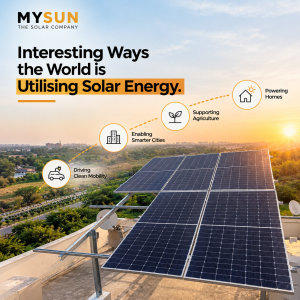
-Team MYSUNInteresting Ways the World is Utilising Solar Energy
Around the world in 80 days, in a tuk tuk, powered by solar? Not really in 80 days! Even though, it would make for a wonderful sequel to the Jules Verne classic, we are not talking about a fictional story here.
An Australian-Indian engineer Naveen Rabelli, has set about on a unique journey where he has planned a trip from Kochi all the way to London in a tuk tuk. Yes, you read that correct. The story would be far more believable if the narrative was written about as much in news as the Solar Impulse aircraft, but it truly is about a man travelling 10,000 odd kilometers in a tuk tuk that is powered by electricity and solar power.
Rabelli has been on the road for seven months now, and hopes to reach Buckingham Palace around mid of September, which would mark the end of this extra-ordinary voyage. The journey was scheduled to be completed earlier, but Rabelli was unfortunately robbed of his passport and cash from the tuk tuk in Sarcelles, north of Paris. Such has been the popularity of the tuk tuk, which cost Rabelli about $1500 upfront and another $11,500 in modifications, that it has been given its own name, Tejas. There is a dedicated Facebook page for the same, that Rabelli maintains to keep all us up to date about his journey. You can follow the same here.
The tuk tuk has a top speed of 60 kmph, and has been a project that Rabelli has worked on for four years now, pouring all his savings into the same. His mission has been to showcase to the world a sustainable and a cost effective solution for transportation while ensuring zero-emission. The tuk tuk, before halting in Paris has crossed about ten countries, starting from India. These include: Iran, Turkey, Greece, Bulgaria, Serbia, Austria, Germany and Switzerland. Being an electric vehicle, the tuk tuk has three lithium-ion batteries that are responsible for running the main motor. In case, there is no socket for power supply, like several villages of India, there is an overhead solar panel that is placed on the tuk tuk to recharge the battery and ensure that the tuk tuk is on the road, moving.
Going has not been easy for Rabelli who had met with an accident, back in India, just before he set out on this epic journey, which delayed the flag off by at least 6 months. There have been flat tyres, mechanical failure and roads have not been too kind. There have been nights on the journey where he has had to unscrew the second seat in the cargo and make a bed to sleep at night in the vehicle alone. On good days, there have been people who have been welcoming and have given him warmth and hospitality that he has been only glad to share with the world via his Facebook page.
As they say, where there is a will there is a way, Rabelli has continued defying the odds and we are sure that the setback in France is not going to dampen his spirits. From the entire team of MYSUN, we wish Rabelli the best and cannot wait for him to reach the finishing line.



 Book your Solar System for just 6,999 and build your personalized payment plan with Flexi-payTM.


