


Author: Arpit
India Files Petition for Initiation of Anti-Dumping Investigation Against China, Taiwan and Malaysia

India's frosty relationship with China seems to be in a never ending circle of news and the latest chapter in the story comes from Renewables Sector. The Ministry of Commerce & Industry has filed a petition for 'initiation of Anti- Dumping investigation concerning imports of Solar Cells whether or not assembled in modules or Panels originating in or exported from China PR and Malaysia'. In a letter dated July 17, 2017, Mithileshwar Thakur, the Additional Director General of Foreign Trade informed the Chinese Embassy in India of the move.

The petition comes on the back of several mummers that have been going around in the recent past owing to the rather weak performance of the Indian manufactured solar cells in the market, with a large percentage of installers and developers preferring to import the cells from China owing to lower costs. As recent as June 30th, in an article by Economic Times, it was mentioned that the manufacturers had reached out to the Government to help them and impose a 'safeguard duty' on the equipment to help level the playing fields at least in terms of the cost. According to the same article, the manufacturers in India had asked for an anti dumping duty of 10 cents per watt on the modules and cells that were imported.
It is a widespread knowledge that of the 5GW+ installed capacity that was commissioned in the year 2016/17, 90% of the solar cells used were either imported from China or neighboring countries like Taiwan or Malaysia. It has been reported that over 1.5GW of manufacturing capacity of solar cells in India has been lying idle simply because of the lack of demand. The Indian Government in the past has pushed the Make in India narrative strongly in the sector, and we saw with the 500 MW Rooftop SECI Subsidy program, it was mandatory to use the domestic modules. However, with India losing the case in the WTO for Fair Trade, it is not beyond the realms of possibility that this time the Government will implement the duty on imported cells. In the immediate term, this would increase the total project cost in the range of about 5-15% in case a safeguard duty of about 20% is imposed. This would also mean in conjunction with GST, which has been recently implemented, in the short term the cost of solar tariffs will go up perhaps back to the Rs 3 mark from the Rs 2.44 that we have seen recently.
While this move will benefit the local players, it will create a barrier for global manufacturers from entering the country, which could prove to be undermining for the industry. It would be interesting to see the response and the investigation into the matter, but more than ever before, if Anti-Dumping has to come, this looks to be as likely a period as ever so far.
Top 9 Things to Keep in Mind To Ensure You Get the Best Solar Modules When you Install Rooftop Solar

Solar modules are the most important component of your solar PV system since this is where the incident sun rays are captured and converted into electricity. Solar modules also are the biggest contributor to the total cost of your solar system. So needless to say, when you decide to go solar, you must pay special attention to picking the best solar modules for your plant.
Dwindling cost of solar modules over a period of time has been one of the key contributors to the cost reduction of solar systems. With improved automated manufacturing processes and cut throat competition in the market, the cost drops have been possible both by the economy of scale and capacity overhang. However, it goes without saying that one must go for the most cost-effective module while ensuring high quality and generation.
Today, one has the luxury of choosing between several modules makes in the market, right from India manufactured modules to global modules. Making the right choice, therefore, can be daunting. While you can refer to one of the lists widely available on the web such as the Bloomberg Tier 1 Module list and cherry pick for an idea, it is best to know what to look for when you decide to choose the modules. Here are nine things that we highly recommend for you, to keep an eye on, when selecting a module for the rooftop solar PV plant.
The cost of the Module:
If you are considering solar, you must be aware of the difference in cost in a module that is made in India and one that is imported from the global market such as, say China. Where a module that is being imported may cost in the region of about Rs 19 to 20 per watt peak for a Tier 1 module, an Indian make will set you back by about Rs 25 to Rs 26 per watt peak. In the coming year, it is widely predicted that the cost of the global module may drop down to about Rs 17 while the Indian module cost may come to about Rs 21-23 per watt peak. The costs here are indicative and landed costs and may vary from manufacturer to manufacturer. The incoming GST may throw a spanner in works, where there is a possibility that the government may put some kind of an import duty on the imported modules, especially to push the ‘Make in India’ initiative. However, for now, going with a global module, will be more cost-effective for your solar plant.
Bill of Material (BOM):
Bill of Material is the material that has gone into the manufactured module and largely determines its quality and cost, therefore, it is a must that you run the BOM past a solar expert before you make a decision. BOM is extremely critical and can be sometimes difficult for a layman to interpret. Both long-term and short-term performance of the plant can be affected by an inappropriate BOM. If you are presented with BOM, keep an eye on the quality of the solar cells used, EVA - Adhesive, back sheet, glass cables, junction box, etc. If the BOM of modules is of an inferior quality, it would lead to a reduction in the lifetime as well as the performance of the solar plant.
Manufacturing process:
How the modules are manufactured also has a strong bearing on the performance as well as the overall cost of the modules. If you are given an opportunity by the module manufacturer to visit the manufacturing facility, you should take a chance and do so. This may be more difficult if the modules are being imported. However, when choosing the partner, do quiz him about the manufacturing process. A simple case may be, that if the partner’s manufacturing process is not automated and requires a lot of manual work then there is a chance of introducing micro-cracks which may grow later under cyclic thermal stress manifesting in various failures. Another possibility could be poor lamination (adhesion or air bubbles) which can hamper the life of the module. Since a layman is not an expert in module manufacturing he has to take the help of an expert.
Power Tolerance:
As a rule of thumb, power tolerance of your module must always be positive. While it is an industry standard now that only modules with positive tolerance are sold, always insist on checking this with your supplier. Ask for the flash test data (I-V characteristic) for each module that has been supplied so that you are sure of the power tolerance of the module that you will be placing on your rooftop and track its performance in future.
Protection:
Most of the modules sold today have a tempered glass of 3.2mm thickness. It is only with this minimum thickness that modules can pass the IEC tests. However, if you live in a region where there is a lot of hail or snowfall or your rooftop is susceptible to things like coconuts falling from trees, you could also consider 4mm thickness glass modules. While more often than not, protection is mentioned in BOM, if need be, you should go into more specifics and details for the same.
Certification: It is extremely important that you go for modules that are certified. If you are already considering solar, do ask for the certifications that the module being offered to you has passed. Some of the certifications that are important are IEC 61215 for design qualification, IEC 61701 for salt mist corrosion testing, IEC 61730 part 1 & 2 for module safety qualification, IEC 62716 for Ammonia Corrosion testing which is advisable for site conditions like dairy, mines, toilets etc. Needless to say, the above standards pertain to Crystalline Silicon modules which are most common for the rooftop installations. If you live in an area that experiences extreme weather conditions, it is a must that you check the certifications to ensure that your modules are tested in the weather condition.
Module Degradation/ Performance Warranty:
Seek the performance warranty from the module manufacturer. Most modules have a degradation rate of 2.5% in the first year followed by a linear degradation of 0.7% year on year for the next 25 years. However, good Tier 1 modules do not degrade on an average more than 0.4% year on year, linear. Even post purchasing, you must keep an eye on the module degradation and hold the seller responsible if the degradation is more than what has been mentioned.
Average Warranty Period:
Tier-1 Global modules generally come with a warranty of 10-12 years against any defect in workmanship. Most of the Indian modules also offer a warranty anywhere in the region of 10-12 years. Be sure of doing a thorough check on the market standing and financial health of the company before picking the modules. A Tier-1 company is most likely to be financially secure and will stand behind its warranty in case something falls apart, whereas a lower rated company, may not be always very keen to listen to complaints and claims post the sale.
Insurance:
In order to be sure and make a secure investment, even if you are setting up a small solar plant, do insist on third party insurance for your modules. You must ensure that module supplier’s warranty is backed by international insurance companies like Munich Re, Power Guard, etc. to safeguard your interests.
Other than the above, a solar expert will also keep a keen eye on AQL (Acceptable Quality Level), IPC (In-process Control), IQC (In coming quality control), OQA (Outgoing quality assurance), Packaging and Field Performance.
While there are plenty of other things for you to safeguard and check when deciding the module partner, these some of the things that you must keep in mind. Since most of these can be quite technical and difficult to understand if you are not from the background of solar, it would be useful to give the task of choosing a module to a technical expert as it can make or break the performance of your rooftop solar plant.
With MYSUN, you can always be assured that the installed projects will feature only the best solar modules, rated Tier-1, with all these pointers already taken care of. In fact, if you need to discuss any of these points with our solar experts, we would only be glad to help. We hope, the information above would help you make a sound and an informed choice.
Image: Topsunenergy With inputs from Mr Gyan Prakash TiwariUttar Pradesh Set to Target 4.3GW of Rooftop Solar Installation as per the new Draft ‘UP Solar Power Policy 2017’: An Overview

With the operating period of the current solar policy of Uttar Pradesh already having expired on March 31, 2017, the Uttar Pradesh New and Renewable Energy Development Agency (UPNEDA) has issued a draft UP Solar power policy in draft for the state. The draft policy is open for comments till July 15, 2017. You can view the draft policy above. The draft policy, once approved, will be operative for 5 years or till a new policy is issued.
According to the UP Solar power policy draft, the state of Uttar Pradesh has a solar potential of 23.8GW and is targeting 10.7GW of commissioned solar power by the year 2022, with 4.3GW of this capacity assigned to rooftops. It is also included in the draft that the state is targeting to provide 24 hours of electricity to both rural and urban households by the year 2018-19. Under the draft solar policy of 2017, solar parks with a minimum 100MW capacity will be set up and the Government will provide incentives to purchase land on lease or usage. It is also mandatory that at least 50% of the power produced from the solar parks will have to be sold to Uttar Pradesh Power Corporation Limited (UPPCL) or a distribution licensee.
To encourage rooftop solar installations, the policy mentions that the Government shall promote and deploy rooftop plants for self-consumption on all State Government and Central Government-owned buildings. As for the incentives, the State Government will provide a subsidy between Rs 10,000/kW and Rs 20,000/kW on the first-come-first-served basis for the first 100MW applications submitted to UPNEDA in the private residential sector. In case the installation is delayed by more than six months, the subsidy will be withdrawn. The subsidy will be disbursed to the customer only after the commissioning of the project and submission of all the documents to UPNEDA. Just like the Solar Policy of Delhi, the height of the module structure will not be counted towards the height of the building and therefore no further permission of construction is needed. The nodal agency, that is UPNEDA will also ensure a single window clearance for all power producers, allowing to expedite the process.
With the policy still under review, we expect further modifications in the content of the UP Solar power policy draft. We are excited to see that the state nodal agency has identified simplification of the process involved in getting permits and approvals as a major thrust area. To provide further support to rooftop solar in the state, the state nodal agency along with the Discoms should work towards better implementation of the Net Metering policy. However, even in the current state, the policy is a much-needed thrust to the solar segment in what is one of the largest states in the country but with a meager 269.26MW of solar power commissioned till the year 2017.
image source: static.wixstaticAnnouncements this Month that Could Impact the Growth of Installed Capacity of Solar in Tamil Nadu

Despite being the state with the highest installed solar capacity of about 1.6GW with 529.15 MW being added in the year 2016/17, Tamil Nadu continues to set an example for other states in its bid to increase the uptake of solar. Within the last week, there have been two key announcements that would encourage those in the state to go solar. The state had initially set a target of achieving 3GW of installed solar power by the year 2019, and these latest set of announcements only further establish the commitment of the state government towards encouraging solar in Tamil Nadu.
The first announcement made in the state assembly is that the Tamil Nadu Government has invited bids for a new tender of 1500MW. Lead by the Electricity Minister, Mr. P Thangamani, it was announced that the state plans to increase the installed capacity of the state further by 5GW in a phased manner. For the first phase, 1500MW tender has been issued under the reverse bidding route. According to the policy note issued, Tamil Nadu harnessed more than 1644 million units of solar energy during 2016-17, with an all-time high generation of 1,498 MW achieved on March 27, 2017.
In the other news from Tamil Nadu, the state utility board, Tamil Nadu Generation and Distribution Corporation (TANGEDCO) could be slashing its net metering tariff from Rs 6.63 or Rs 7.23/ kWh to one-third at Rs 2.20/ kWh. This proposal comes on the back of record-breaking low solar tariffs that have been achieved, which makes the current tariffs look obscenely high. A domestic consumer with 'Low Tension' or LT connection today is eligible for a net metering rate of Rs 6.63/kWh while a consumer with 'High Tension' or HT connection receiving Rs 6.91/kWh. In the case of commercial consumers, the rates go up to Rs 7.01 and 7.23 per kWh for LT and HT respectively. With only 91 MW of rooftop capacity so far in the state-approved, it is unclear how this move would help to uptake rooftop solar.
In MYSUN’s view, this proposal if made into a policy could have a negative impact in the push for rooftop solar. Net-Metering has been one of the chief reasons why rooftop solar financially has been so lucrative and slashing the rates will have an impact on the overall return on investment from the project. This decision must be made cautiously as it can have a negative impact and further slow down an already slow-moving deployment.
On the new 1500MW tender, we believe, the recent project auctions of solar in Tamil Nadu have proven to be quite disappointing with bids of the only 117MW received in the 500MW tender in February and just 300MW bid in the 500MW tender that was floated in November last year. It would be interesting to see in the wake of GST just around the corner, and there still a few questions marks looming on the effect of the same on solar, what kind of interest will this tender see. Also worth emphasizing is that the maximum upper tariff limit has been set at Rs 4/kWh for the project and a judicious timeline of 12 months for projects up to 50MW and 24 months for projects above 50MW has been given. With rather relaxed time frames and very reasonable upper tariff limit, at least on paper, this looks like a great opportunity.
How is Solar Energy Produced and What are the Different Types of Solar Systems?
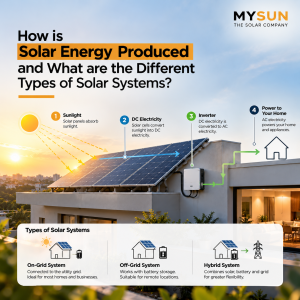
With over 300 sunny days in most locations throughout the year, India is an ideal country when it comes to solar energy. It is because of this tremendous solar potential that the Central Government has set a target of achieving at least 100GW of installed capacity from solar in a bid to move towards renewable sources of energy. While this 100GW is to be achieved in defined proportions from rooftop solar and ground mounted solar, solar as a fundamental technology works identically for both the cases.
How is solar energy produced?
Solar PV (Photovoltaic) modules, which contain cells which are connected in series, are typically placed on rooftops or ground. When the sun rays strike them, they convert sunlight into direct current (DC) electricity. Since our home appliances run on alternating current (AC), it is mandatory to convert this generated DC power into AC. This is achieved by installing an Inverter. The output of the inverter is generally connected to the building mains.
But for large consumers like commercial or industrial buildings, where the solar system size is bigger, say more than 100kW, we may need to step up the voltage to 11kv or 33kV by using a step-up transformer. In this case, the output of the inverter is connected to a step-up transformer and the output from the transformer is connected at the main HT panel (11/33kV). In India, there are generally three types of solar systems that are most common: Grid Connected, Off Grid and Hybrid.
Types of solar systems:
- Grid connected systems also known as on-grid systems, are connected to the building mains and supply power to the connected load as long as the grid is energized. Priority is first given to the generated solar power and only if the consumption is more than the generation of the solar system, is the grid power sourced. Solar inverters come with a special security feature called Islanding protection that prevents backflow of solar power to the grid, in the event of a grid failure. If you opt for a grid connected solar system, you are eligible to make an arrangement called Net-Metering. This is a special arrangement with the approval of your local Distribution Company (DISCOM) that allows you to optimize the utilization of generated solar power. With net metering, the extra solar power generated is fed back into the grid, and the customer is accordingly compensated by the DISCOM.
- Off-grid solar systems are set up independently from the state grid. Here generated solar power can be supplied to the dedicated load with the help of a battery backup system. When generated solar power is more than the load requirement, extra power can be stored in the battery and the same power can be utilized in the event of low generation or during non-generation hours. Off-grid systems generally are less efficient than the on grid systems and are more expensive, requiring the battery to be replaced every 5 years. These are recommended only for areas where there is no power or a very erratic power supply.
- A hybrid system, as the name suggests, is a combination of on-grid and off-grid solar system. A hybrid solar system has a battery bank with an inverter which can work as an on grid as well as an off-grid system. Generated solar power can be utilized to supply connected load or for charging the battery bank. Just like an on-grid system, any extra power generated by the hybrid system can be supplied back to grid, if the battery is fully charged. In the event of grid failure, just like an off-grid system, the energy stored in storage batteries can be utilized for supplying to the dedicated load connected to the system. Hybrid systems can also have other sources of power such as DG or wind alongside solar and grid.
Let's Talk about the Technology Involved in Solar:
Taking a little deeper dive into technology, we can broadly categorize Solar PV into crystalline silicon and thin film. Crystalline Silicon can be further categorized into mono and multi-crystalline silicon whereas thin film can be categorized as amorphous silicon, Cd-Te (Cadmium Telluride), CIGS (Copper Indium Gallium), CIG (Copper Indium Gallium) etc. The main difference between these is the material that they use as well as their manufacturing processes. Generally, multi-crystalline silicon is used in most solar systems and has a proven generation record of more than 30 years. Multi-crystalline comprises of 80-85% of the overall market share.
If you are considering going for solar at your home, office, industrial or commercial building, there are also a couple of ownership models that you can choose from. You can choose to install and own the solar system (CAPEX Model) or just purchase the solar power from a system owned by a third-party/ individual and you only have to pay for the energy consumed at the rate that has been contractually agreed. In case you wish to own the system, you will have to bear the cost of the system, there are however numerous bank financing options available (RESCO Model). In case you decide to only buy solar power, you will have to lease out your rooftop/ ground area to the third-party that you sign the contract with.
With options galore and cost for going solar coming down substantially in the last few years, there is absolutely no excuse for you to not go solar. The grid tariffs are set to continue to rise over the next several years, and solar gives you the luxury of a low fixed tariff, prompting major savings on your electricity bill, over the next 25 years. Going solar is like discovering a pot of gold, especially for industrial and commercial users. Since solar requires negligible maintenance too, it is as good as planting a tree and enjoying the benefits of it for several years to come. What’s more is that you make your contribution towards reducing the carbon footprint and set an example before everyone prompting the march towards solarization.
image source: energynext
Why Should Every Large or Small Industry Consider Rooftop Solar to Improve Profitability
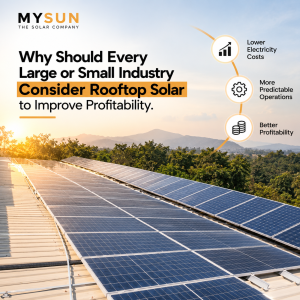
Industries constitute more than 45% of the electricity consumption in India. The landed electricity tariff for industries on an average is 6 Rs./unit. (Industries have two types of customers, viz., LT and HT. LT is 400 V and below and HT is 11 kV and above. Bulk of the industry buyers of electricity are in HT segment. The highest tariff is in Maharashtra at Rs.7.48/kWh. At second spot is Delhi where the tariff for HT customers is Rs.7.25/kWh. The tariff for LT customers is higher but their share in the overall consumption is only 6% in India as compared to 21% for HT. In LT segment as well the highest tariff is in Delhi (Rs.9/kWh) followed by Maharashtra at Rs.7.60/kWh and UP at Rs.7.30/kWh). Bulk of electricity in India is generated from power plants based on coal. As the cost of coal, transportation, labour and disposal of ash increases y-o-y, an annual increase of 4% in electricity tariff is expected and the same has been the trend historically too. Industrial and Commercial consumers will continue to cross-subsidize domestic and agricultural sectors.
Most industrial consumers have large connected loads and many of them partially or fully use their power requirement through diesel generators. These industries have big enough rooftops suitable for 100-300-500 KWp solar installation. They also have a variety of loads, some of which cater to the process requirement which cannot be compromised and others are office and building loads. A rooftop solar plant can be connected to the LT side or through a smart controller to diesel generator which either reduces the total import of electricity or reduces consumption of diesel or both.
If the industry has larger roof-top then even more than 1 MWp capacity can also be installed either under net metering policy or as a captive power plant. As captive power producer, the industry can also claim accelerated depreciation if it is a profit earning entity, which further increases the viability and savings from solar. They can also earn some Solar RECs which can be traded in power exchange at the market rate. In case, the industry is one of the obligated entities the units consumed by it can be offset from its total obligation. Thus, solar shall not be regarded just as a clean and green energy but as a viable energy alternative which provides a good hedging to the certainty in electricity rate increase in future and saves energy cost for the industries. As far as exact savings from solar is concerned, the situation is no-size-fits-all. Each state has its solar policy and as per their solar policy they stipulate following things:
- Wheeling charges
- Wheeling losses
- Cross Subsidy Surcharge
- Banking charge
- Time of day charge
- Electricity duty
- What percentage of solar capacity is allowed for an existing customer
- Metering point and metering details
- SLDC charges
On top of above, it is the location of the consumer which will decide the solar yield and hence the economics. Besides economics, it also helps in energy security and sends a message to the customers of industry on its readiness to adopt environment-friendly technologies.
Three key things, that I would suggest to take note when deciding upon going with a rooftop solar PV plant for your industry or commercial building are:
- While deciding on the capacity to be installed, 25-30% of the overall average load is the safe bet.
- Some industries are reluctant to spend capex and often want solar power under open access. This alternative shall be evaluated in totality as the open access charges are normally to be paid by the consumer and may upset the economics of solar vs. grid power. Also, some discoms are reluctant to grant permission for solar installation as they do not want to lose prized customers.
- Electricity Duty has to be considered while evaluating the financial proposal as despite not using the state grid this charge is payable on each unit of solar electricity consumed by industry. Some states have waived it for solar under their policy for a definite period though.
This article has been contributed by Dr Amitabh Verma, CTO at Solar Power Aditya Birla. He has lead projects in Gujarat, Rajasthan, Telangana etc adding up to a capacity of 80 MW in total. He is a dear contributor at MYSUN as a guest author.
Image source: RMI Outlet
Going Solar in Haryana Will Be Even More Affordable: VAT Exempted from Solar Equipments

Just days after it was reported that the Central Government will be providing customs and excise duty exemptions for rooftop solar projects, there is more good news for those who are exploring the idea of going solar in Haryana. The Haryana Government has decided to exempt VAT on equipment and parts used in the installation of a solar plant in Haryana. This would bring the cost down of the solar plant a fair bit. Haryana is not the first state though to exempt VAT from solar equipment with the states like Punjab, Uttar Pradesh, Delhi, Maharashtra and Madhya Pradesh already taking the stand(link all the solar policies of these states).
The decision to exempt VAT was taken jointly by the Haryana Cabinet in Chandigarh. Chasing a target of 4200MW of solar power by 2022, a move like this will invite and encourage more developers and installers to set up projects in the state. It has been estimated that this move would cost the state an approximate Rs 2.30 crore, which is a small price to pay to help encourage the adoption of solar. While the obvious components used in a solar plant are exempted, it has also been notified that readily available solar products such as the solar lantern, pumping system as well as spare parts will be exempted from VAT. Some of the other products that have been exempted from VAT of 5% include alternators, inverters, solar chargers, electricity meters, street lighting systems, solar home system etc.
MYSUN's view: We believe that this is indeed a positive step, especially on the back of announcements like last year where a 90% subsidy was given to promote equipment like the solar water pumps to encourage people to install solar in Haryana. Instead of providing subsidies which may not be always very easy to avail, the Government has decided to make the system more affordable right at the point of buying which is much simpler and useful. We hope that more states would follow the lead of the likes of Haryana and exempt VAT from solar equipment. However, with GST just around the corner and expected to be brought mainstream in July, it would be worth watching how that would play out.
Image Source: Drink Blue Save Green
Customs and Excise Duty Benefits for Rooftop Solar Projects Available Now

Image Source: pvEurope
Underperforming Rooftop Solar Plants Risk Losing Subsidies: A Step in the Right Direction

It is no secret that the timelines for subsidy driven rooftop solar projects are quite tight given that the installers or developers have to find the customers, close contracts, get net-metering approvals, install the project and get the inspection done, all in a short time-frame of approximately 12 months. However, often we see that due to one weak link in the chain, the project is stretched and the execution has to be hurried and last moment compromises are made to meet the strict deadlines, which has financial implications. This is one situation where the quality of the solar system can potentially be compromised, the other one being the very aggressive bidding solar companies do to win these projects. Another familiar tale is that the power generation from these projects is not up to the mark due to lack of proper maintenance.
In order to deal with these situations and ensure that all the small rooftop solar PV plants, both off grid and on grid are performing close to their potential, Central Government has announced that they will start monitoring the performance of the plants closely. In case the plants are performing less than 40% of the theoretical capability, irrespective of the reason, the financial incentives that were promised to the plants will not be given. All the consumers, including the government departments who are planning to install solar as mandated by several states, will have to take account of the new notice and ensure that at all times at least 40% efficiency of the plant is maintained. This is the first time that the Government has come down hard on the quality aspect and linked generation of the plant to the incentive.
It has been reported that the reason the government has taken this caution is that several institutes, while have installed rooftop solar as per the mandate, have not cared about maintaining the system and therefore the generation from these plants has been poor. This results in not only fewer savings, but also results in lower trust in solar amongst this category of consumers, thereby negating the core proposition of going solar. The mandate to maintain at least 40% efficiency has come into effect from April 4, 2017, and therefore it is now mandatory for all upcoming rooftop solar plants to abide by it. On the other side of the story, the Government is also promising to reward the plants that are well maintained and doing well. Maximum subsidy has been promised for plants that are consistently generating more than 80% of their theoretical strength. Below is the new incentive structure based on the plant performance that has been issued by MNRE.
| Incentives offered by MNRE | |
| For solar plants achieving performance > 80% potential | |
|
Rs 16,250 |
|
Rs 39,000 |
| For solar plants achieving performance between 50-80% | |
|
Rs 9,650 |
|
Rs 23,400 |
| For solar plants achieving performance between 40-50% | |
|
Rs 6,500 |
|
Rs 15,600 |
At MYSUN, we believe this is a well-intended proposition from the Government but like many such initiatives, it has to be implemented well. Also, since the incentive is to be rolled out in the first couple of years from the date of installation and commissioning of the solar plant, this policy alone does not ensure the 25 year long term performance of the solar plant. To achieve that, one needs to ensure that the right quality standards for the system design and the critical components are defined and adhered to. However, this is a welcome step towards achieving that goal.
Credits: Deccan Chronicle.
Rooftop Solar Plant at the Sardar Vallabhbhai Patel International Airport Gets Commissioned
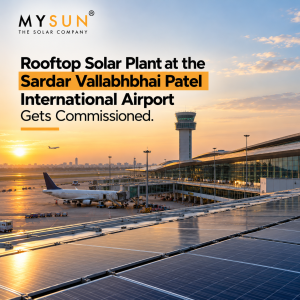
After the Cochin airport famously went 100% solar, Ahmedabad's Sardar Vallabhbhai Patel International Airport has joined the list of airports in India to sport a rooftop solar. The Airport Authority of India, responsible for pushing this initiative has commissioned a grid connected 700 kWp rooftop plant at the Ahmedabad Airport. Incidentally, the 700 kWp plant is the largest rooftop project commissioned in Ahmedabad, which is likely to set an example for other major Commercial and Industrial players. The power produced by this solar plant will be utilized to power the Terminal 1 building.
Just like most of the rooftop plants in India, the rooftop plant at the Ahmedabad airport has a Net Metering system, which allows all the unutilised power that the system has generated to be fed back into the state grid. With the announcement made to solarise at least 7000 Railways Stations in the Union Budget, it is nice to see that the government and public utility spaces are looking to solar rooftop in helping the country reach the target of 40GW for rooftop solar by 2022. Other than the airports in Cochin and Ahmedabad, several other airports such as those in Delhi, Hyderabad, Kisangarh, Chandigarh etc have installed solar power plants.
MYSUN's View: We at MYSUN believe that this is indeed a positive step. With large empty spaces on the field as well as big rooftops and large electricity requirements, airports are ideal sites for solar installations. With a power requirement of 24x7, solar can actually play a crucial role in not just supplying a large part of this power but also reducing the electricity bills of these buildings. Beyond this, having rooftop solar installed at airports is a great advertisement for the power of solar and works as a great real-time demonstration to the travelers, who would definitely get inspired to replicate the same at their homes and in their workplaces. We would like to see all the airports take to rooftop solar and earn the benefits that the solution brings to the table.



 Book your Solar System for just 6,999 and build your personalized payment plan with Flexi-payTM.


